Share

Its our Birthday + the UK takes back control, over ai, social media and have a look what that really means inside
 โ€Œ โ€Œ โ€Œ โ€Œ โ€Œ โ€Œ โ€Œ โ€Œ โ€Œ โ€Œ โ€Œ โ€Œ โ€Œ โ€Œ โ€Œ โ€Œ โ€Œ โ€Œ โ€Œ โ€Œ โ€Œ โ€Œ โ€Œ โ€Œ โ€Œ โ€Œ โ€Œ โ€Œ โ€Œ โ€Œ โ€Œ โ€Œ โ€Œ โ€Œ โ€Œ โ€Œ โ€Œ โ€Œ โ€Œ โ€Œ โ€Œ โ€Œ โ€Œ โ€Œ โ€Œ โ€Œ โ€Œ โ€Œ โ€Œ โ€Œ โ€Œ โ€Œ โ€Œ โ€Œ โ€Œ โ€Œ โ€Œ โ€Œ โ€Œ โ€Œ โ€Œ โ€Œ โ€Œ โ€Œ โ€Œ โ€Œ โ€Œ โ€Œ โ€Œ โ€Œ โ€Œ โ€Œ โ€Œ โ€Œ โ€Œ โ€Œ โ€Œ โ€Œ โ€Œ โ€Œ โ€Œ โ€Œ โ€Œ โ€Œ โ€Œ โ€Œ โ€Œ โ€Œ โ€Œ โ€Œ โ€Œ โ€Œ โ€Œ โ€Œ โ€Œ โ€Œ โ€Œ โ€Œ โ€Œ โ€Œ โ€Œ โ€Œ โ€Œ โ€Œ โ€Œ โ€Œ โ€Œ โ€Œ โ€Œ โ€Œ โ€Œ โ€Œ โ€Œ โ€Œ โ€Œ โ€Œ โ€Œ โ€Œ โ€Œ โ€Œ โ€Œ โ€Œ โ€Œ โ€Œ โ€Œ โ€Œ

Colorintech Weekly - 300

(View this version on the web)

Hey


Its our BIRTHDAY - Yes 300 Editions strong๐Ÿฐ. That means pretty much for the last 6 years we've been in your inbox weekly every Wednesday monring- so if you do want to buy us a virtual cupcake to say thanks grab us one here๐ŸŽ


So if you snooze you lose. We had free London Tech week tickets for this week but they're all gone. But don't worry for BTF we have some things we'll throw in with some of our tickets which will make you jump for joy so watch this space


Check out the AI Podcast version of this newsletter or the Video version on our Socials


This newsletter is free, but if you do want to get us a summer ice cream๐Ÿฆ as a thank you for 300+ editions grab us one here๐ŸŽ

Oh and if you missed an edition, you can find it here or this platform, here

๐Ÿ—ž๏ธDiversity and inclusion news๐Ÿ—ž๏ธ

๐ŸŽ“ Getting a Job Might Soon Be More Competitive Than Getting Into Oxford


TL;DR M&S has announced 1,000 new trainee roles for young people as youth unemployment continues to climb. The good news? Companies are finally paying attention. The bad news? More than a million young people are now out of work, education or training, and getting an entry-level job is starting to feel like applying to an elite university. ๐Ÿ˜ฌ


Marks & Spencer has announced a new programme that will create 1,000 paid training placements for 16-24 year olds across the UK and Ireland.

The move comes as youth unemployment continues to rise.

More than 1 million young people are now classed as NEETs (Not in Education, Employment or Training) โ€” the highest level in over a decade.

A recent review commissioned by the government warned Britain is at risk of creating a "lost generation", with one in six young people potentially falling into this category within five years if nothing changes.


For years, the promise was simple:

๐Ÿ“š Study hard.

๐ŸŽ“ Get qualified.

๐Ÿ’ผ Get a job.

The problem is the final step is becoming increasingly difficult.

One young graduate told the BBC he had applied for more than 400 jobs and secured just one interview.


Entry-level jobs are shrinking. Graduate schemes are oversubscribed. Retail and hospitality โ€” traditionally the first rung on the career ladder โ€” are hiring less.

Meanwhile AI is beginning to automate many of the junior tasks that used to help people get their foot in the door.


This isn't just a youth unemployment story.

It's a social mobility story.

Companies regularly complain about talent shortages.

Young people regularly complain nobody will hire them.

Both can be true.

We're creating a labour market that increasingly demands experience while offering fewer opportunities to gain it. ๐Ÿคท๐Ÿพโ€โ™‚๏ธ


The M&S scheme is a genuinely positive step.

But 1,000 opportunities is a drop in the ocean when more than 1 million young people are currently disconnected from work or education.

The real challenge isn't helping young people climb the ladder.

It's making sure the ladder still exists. ๐Ÿšจ

Read more:

https://www.bbc.co.uk/news/articles/cr7xr3dvxp9o

https://www.bbc.co.uk/news/articles/cy026x9jpd0o

๐Ÿง Things that make you go hmmm๐Ÿง 

๐Ÿค–๐Ÿ“ต The UK Just Told Apple and Google: Stop letting Kids Send Nudes. Or Else. ๐Ÿ“ˆ

TLDR; Keir Starmer has given Apple and Google three months to stop children taking, sharing and viewing nude images on their devices. The objective is difficult to argue with. The technical, privacy and regulatory consequences are another matter entirely. ๐Ÿ‘€


Speaking at London Tech Week, Starmer gave technology companies until September to introduce protections preventing under-18s from taking, sharing or viewing sexually explicit images on smartphones and tablets.

Fail to comply, and the government says legislation will follow โ€” potentially including fines and criminal liability for senior executives. โš–๏ธ


The political case is straightforward.

  • ๐Ÿ“Š The National Crime Agency receives around 1,700 child abuse referrals every week.

  • ๐Ÿ“Š 91% of child sexual abuse reports in 2024 contained self-generated content.

  • ๐Ÿ“Š The average child now encounters pornography by age 13.

The government's argument is simple: if technology companies can build AI models capable of generating videos, writing essays and understanding images, surely they can stop a teenager sending a nude photo.

It's a compelling headline.

It's also where the easy part of the conversation ends.


๐Ÿค– The Technical Reality Is Far More Complicated

The proposal is being presented as though it's simply a case of "switching on" existing technology.

It isn't.

To make this work at scale, devices would likely need some combination of:

๐Ÿ“ฑ Age verification

๐Ÿ“ฑ Content classification

๐Ÿ“ฑ Image scanning

๐Ÿ“ฑ Operating-system-level intervention

๐Ÿ“ฑ Rules determining what content gets blocked and what gets through

In other words, your device needs to look at content, classify it, and make decisions on your behalf.

That's not a minor product update.

That's a significant change in how personal devices operate.

And it raises a question politicians seem reluctant to answer directly:

How much visibility into user behaviour are we comfortable giving operating systems in pursuit of safety? ๐Ÿ”


๐ŸŽจ The False Positive Problem

The announcement also glosses over something every AI engineer already knows: Context is hard.

Can a system reliably distinguish between:

  • ๐Ÿฅ Medical imagery

  • ๐ŸŽจ Art and educational content

  • ๐Ÿ“š Biology coursework

  • ๐Ÿšจ Abuse material

  • ๐Ÿ“ธ Consensual adult content

The answer is probably most of the time.

The problem is that "most of the time" isn't the standard people expect when technology starts blocking communications, restricting content or verifying identity.

We've spent the last decade discovering how difficult content moderation is for social media companies.

Now we're proposing that operating systems solve a version of the same problem automatically.


๐Ÿ” The Privacy Trade-Off Nobody Wants To Talk About

The government insists this isn't surveillance. Privacy campaigners insist it is.

The truth is more nuanced.

No one is suggesting your photos are suddenly being uploaded to Whitehall.

But if devices are required to inspect content before deciding what can be viewed, shared or stored, then we are undeniably moving further towards device-level content governance.

That's a significant precedent.

Because once the infrastructure exists, the obvious question becomes:

What's next?

Today it's child sexual abuse imagery.

Tomorrow it could be:

  • ๐Ÿšซ Social media access for under-16s

  • ๐ŸŽฐ Gambling content

  • ๐Ÿค– Deepfake content

  • โš ๏ธ Extremist material

  • ๐Ÿ“ฐ Misinformation

  • ๐Ÿ’ธ Financial scams

  • ๐Ÿ‘€Political campaigns

  • ๐Ÿ—ฃ๏ธUnpalatable opinions

  • ๐Ÿ˜ตโ€๐Ÿ’ซOpposition to any government action

Every one of those categories has genuine public-interest arguments behind it.

That's precisely why this debate matters.

The slippery slope argument is often dismissed.

But technology regulation rarely moves in reverse.

Once governments establish a capability, they usually find new reasons to use it.


This story is less about nude images and more about power.

For years, Silicon Valley's implicit position has been:

"We build the tools. Society decides how to use them."

Governments are increasingly rejecting that argument.

The UK's position is becoming:

"If your products contribute to a social problem, you are responsible for helping solve it."

That's a profound shift.

We're moving from regulating platforms to regulating capabilities.

The question is no longer:

"Should harmful content be removed?"

It's becoming:

"Should technology be designed so certain behaviours become impossible in the first place?"

That's a much bigger conversation than most headlines suggest. ๐ŸŒ


๐Ÿฟ So What?

Most people will instinctively support protecting children online.

The harms are real. But good intentions don't eliminate trade-offs.

The real debate isn't whether children should be safer online.

It's what technical infrastructure we're willing to build to make that happen.

Because if the answer is age verification, content scanning and operating-system intervention, then we're not just talking about child safety anymore.

We're talking about creating a precedent where governments can require technology companies to redesign products around public policy goals.

Maybe that's necessary.

Maybe it's overdue.

But it's also worth asking where that logic ends.

Because the real story isn't whether Apple and Google can do this.

It's what governments ask them to do once they can. ๐Ÿ‘€

Read more:

๐Ÿ”— The Guardian:
https://www.theguardian.com/technology/2026/jun/08/starmer-tech-firms-ultimatum-block-explicit-images-children-phones

๐Ÿ”— BBC:
https://www.bbc.co.uk/news/articles/cly752ydjw6o

๐Ÿ“ฑ๐Ÿ‡ฌ๐Ÿ‡ง Britain Has Decided It Would Quite Like Its Own OpenAI After All๐Ÿ’ธ


TL;DR

After years of watching its best AI companies get acquired and its biggest institutions rent intelligence from Silicon Valley, Britain is backing a homegrown challenger. Cosine says it's building the UK's first sovereign frontier AI model. The question is whether Britain is finally building AI infrastructureโ€”or just arriving fashionably late to the AI party. ๐ŸŽฉ


London-based AI startup Cosine has assembled an unusually heavyweight coalition to help design Lumen Sovereign, what it describes as Britain's first sovereign frontier AI model.

Among those backing the initiative are:

๐Ÿฆ Lloyds, NatWest and LSEG

๐Ÿ“ก BT

๐Ÿ›ก๏ธ BAE Systems, Leonardo, Thales and Babcock

๐Ÿ’ผ PwC

๐Ÿ“ฑ Telefรณnica Tech


The model will be trained entirely in the UK on Isambard-AI, one of Europe's most powerful supercomputers, using compute allocated through the government's ยฃ500 million Sovereign AI programme.

Unlike many AI systems today, Cosine says Lumen Sovereign is being built from scratch using proprietary datasets rather than adapting an existing open-source model. The company says organisations will be able to run it entirely inside their own infrastructure without sending data to external providers.

The target is deployment readiness by the end of 2026. ๐Ÿš€


There's a slightly awkward reality hanging over this announcement.

Britain has spent the last decade telling the world it's an AI superpower. And to be fair, it has produced some remarkable companies.

The problem is that many of them eventually ended up belonging to someone else.

DeepMind? Google.

Arm? SoftBank.

Most frontier AI? OpenAI, Anthropic, Google or Meta.

The UK became incredibly good at producing AI talent while remaining surprisingly bad at owning the infrastructure that talent created. ๐Ÿคท๐Ÿพโ€โ™‚๏ธ

Lumen Sovereign is essentially an attempt to answer an increasingly uncomfortable question:

What happens if AI becomes critical infrastructure and all of it belongs to somebody else? (The EU is also asking this question so check out its response)


For banks, defence contractors and public institutions, that question is starting to feel less theoretical.

As AI becomes embedded into everything from cybersecurity and fraud detection to healthcare administration and military systems, dependency on a handful of American providers starts to look less like convenience and more like strategic risk. ๐Ÿ”’ And Trump knows it too, which is why he is trying to "make a deal" of his own similar to that of his with Intel with the other Frontier AI companies

The ambition here is significant.

The scale is... relative. ๐Ÿ˜…

The UK Government's Sovereign AI programme is backed by ยฃ500 million.

That sounds like a lot until you compare it with what's happening across the Atlantic.

According to data compiled by Visual Capitalist, Microsoft, Amazon, Alphabet, Meta and Oracle collectively spent around $448 billion on AI infrastructure in 2025 alone, with quarterly spending exceeding $140 billion by the end of the year.


Put another way:

๐Ÿ‡ฌ๐Ÿ‡ง Britain is investing hundreds of millions.

๐Ÿ‡บ๐Ÿ‡ธ Big Tech is investing hundreds of billions.

This isn't David versus Goliath.

It's David trying to build his own sling while Goliath is ordering another hyperscale data centre.

Which is precisely why Cosine isn't trying to build the next ChatGPT.

Nobody in defence, banking or critical infrastructure is desperately asking for a slightly funnier chatbot.


What they want is control. Take back control eh, that sounds familiar ๐Ÿ˜…

Control over where models run.

Control over where data goes.

Control over who can switch the lights off.

That's why the rise of "sovereign AI" is becoming one of the most important trends in the industry. AI is increasingly being viewed less like software and more like energy, cloud infrastructure or telecommunications.

And countries generally don't like discovering that critical infrastructure is controlled somewhere else. ๐ŸŒ (Remember (Huawei)


The funny thing about Britain's AI strategy is that we've spent years celebrating ourselves as a world leader in AI while largely outsourcing the "AI" part to America.

This project suggests Whitehall may finally have noticed.

Whether Lumen Sovereign succeeds or not is almost beside the point.

The bigger shift is that governments and large institutions are starting to ask a different question.

Not:

"Who has the smartest model?"

But:

"Who owns the model we're depending on?"

The AI race is no longer just about intelligence.

It's about sovereignty, resilience and control.

Because nobody wants to wake up one morning and discover the digital equivalent of the national grid is effectively rented month-to-month from California. ๐Ÿ‡ฌ๐Ÿ‡งโšก

Read more:

https://tech.eu/2026/06/08/cosine-secures-industry-backing-for-britain-s-first-sovereign-frontier-model/

https://www.innovationnewsnetwork.com/uk-industry-giants-develop-sovereign-frontier-ai-model/70513/

๐Ÿ“ฑThe EU Just Told Meta It Can't Keep WhatsApp's AI Playground to Itself Like Its Own OpenAI After All๐Ÿ’ธ


TL;DR The EU has ordered Meta to let rival AI chatbots access WhatsApp for free while it investigates whether the company unfairly blocked competitors. Translation: Europe thinks Meta is trying to turn WhatsApp's 2 billion users into an exclusive distribution channel for Meta AI. ๐Ÿฟ


The European Commission has ordered Meta to restore access to WhatsApp for rival AI assistants, including competitors like OpenAI, while an antitrust investigation continues.

The dispute centres on Meta's decision last year to block third-party AI assistants from WhatsApp's Business API while allowing its own assistant, Meta AI, privileged access.


The EU's view is pretty simple:

If WhatsApp is one of the world's largest messaging platforms, Meta shouldn't be allowed to use that dominance to give its own AI products an unfair advantage.


Meta disagrees.

Its response was essentially:

"Why should OpenAI and other AI companies get access to a product businesses pay for?"

The company plans to appeal. โš–๏ธ


For most of the AI boom, everyone has focused on who has the smartest model.

The EU is asking a different question:

Who controls distribution?

Because history suggests the winners in technology aren't always the companies with the best products.

They're often the companies that own the route to customers.

Google had search.

Apple had the App Store.

Microsoft had Windows.

Meta has WhatsApp, Instagram and Facebook.

And increasingly, AI companies are realising that getting people to use your model may be harder than building it.

The real battleground isn't intelligence.

It's distribution. ๐Ÿ“ฑ


There's a reason Meta is fighting this so hard.

Every major tech company is currently trying to answer the same question: Where will people actually use AI?


The advantage of owning WhatsApp isn't just the messages.

It's owning the place where people spend their time.

The EU worries that if Meta controls both the platform and the AI assistant, rivals never get a fair shot.

Meta worries Europe is effectively forcing it to subsidise competitors.

Both arguments have some merit.

But it's another example of a broader trend:

Europe increasingly sees AI competition as too important to leave to market forces alone. ๐Ÿ‡ช๐Ÿ‡บ


So What?

The assumption has been that the AI race will be won by whoever builds the smartest system.

The EU seems to think it might instead be won by whoever controls the front door.

And if that's true, WhatsApp may be far more valuable than the chatbot sitting inside it. ๐Ÿšช๐Ÿค–

Read more:

https://www.bbc.co.uk/news/articles/cn8qj8wjgxwo

https://www.reuters.com/world/eu-regulators-order-meta-allow-rival-ai-chatbots-free-access-whatsapp-2026-06-09/


๐Ÿค– Argentina Wants AI Companies to Have More Rights Than Some Humans


TLDR: Argentina's President Javier Milei wants to create a new legal category for AI-run companies that can operate without any human management. It's either a bold experiment in technological capitalism or the plot of a sci-fi film that should have ended at the first draft. ๐ŸŽฌ


In a surprisingly real sentence that now exists in 2026, Argentina has proposed creating "non-human corporations" โ€” companies operated entirely by AI agents, with human shareholders optional.

The proposal forms part of President Javier Milei's plan to make Argentina a global hub for AI investment.

His vision rests on three pillars:

  • ๐Ÿค– Keep AI largely unregulated

  • ๐Ÿข Create a legal category for AI-run corporations

  • ๐Ÿ’ฐ Offer low taxes and a business-friendly environment

Milei's argument is that just as the limited liability company helped unlock the Industrial Revolution, AI corporations could unlock the next era of economic growth. He wants Buenos Aires to become for AI what Amsterdam was for global trade in the 17th century (Yep the same century when it was in vogue to ship Black people in shackles around the world as slaves for a price)


Most AI policy debates ask:

"How should we regulate AI?"

Argentina is asking something much stranger:

"Should AI be allowed to run companies?"

That's a fundamentally different conversation.

Today, if a company breaks the law, makes a reckless decision or causes harm, there are usually humans somewhere in the chain who can be held accountable.

A non-human corporation complicates that.

Who gets blamed when the CEO is effectively an algorithm?

Who goes to court?

Who goes to prison?

Who explains themselves before a parliamentary committee?

Good luck serving legal papers to GPT-12. โš–๏ธ


The irony is that Milei cites the Dutch East India Company (Yes That company) as an inspiration for this new corporate model.

Historians might politely describe that as a bold choice.

The Dutch East India Company helped pioneer modern capitalism.

It also pioneered some rather less celebrated things, including colonial monopolies, exploitation and corporate power on a scale the world had never seen.

That's precisely why historian Yuval Noah Harari has sounded the alarm.

His concern isn't that AI companies will become smarter than humans. It's that they could become more persistent, more scalable and harder to hold accountable than human-run corporations ever were.

We've spent centuries figuring out how to regulate human greed. We haven't yet figured out how to regulate a corporation that never sleeps, never retires and doesn't care about prison sentences. ๐Ÿ‘€


So What?Most AI discussions focus on replacing jobs.

This is one of the first serious proposals focused on replacing management.

The real question isn't whether AI can run a company.

It's whether society is ready for companies that effectively run themselves. Once you create a corporation that can hire people, deploy capital, lobby politicians and pursue its own objectives without human oversight, you're no longer debating AI tools.

You're debating a new kind of economic actor altogether.

And if that sounds slightly dystopian, it's worth remembering:

The proposal was published as a serious piece of government policy, not a Black Mirror script. ๐Ÿฟ

Read more:

https://www.ft.com/content/f93022fe-43f7-437d-abd8-06c457c0a43c

https://futurism.com/artificial-intelligence/argentina-legalize-non-human-corporations-ai


Image credits - Gage Skidmore

๐Ÿ‘ฉ๐Ÿฟโ€๐Ÿ’ปFor the creators๐Ÿ‘ฉ๐Ÿฟโ€๐Ÿ’ป

๐Ÿ“ˆ The tools behind the tech๐Ÿ“‰

๐Ÿ“ฆProduct๐Ÿ“ฆ

๐Ÿ“Design๐Ÿ“ 

๐Ÿ‘ฉ๐Ÿฟโ€๐Ÿ’ปCode๐Ÿ‘ฉ๐Ÿฟโ€๐Ÿ’ป

๐ŸขThe business behind the tech๐Ÿข

๐Ÿ›๏ธTech deal of the week๐Ÿ›๏ธ

Thye give you the cable but not the plug. Well at under a tenner charge 4 things with one socket why not 


Link here and check out our other deals too


And view our shop with our whole collection here


๐Ÿ˜…Meme/AI video of the week ๐Ÿ˜… (the internet can be savage lol)

๐ŸŒPartner Events & Opportunties ๐ŸŒ

Below are the top opportunities we want to highlight to you this week! If you want to see more, then check out our new website where we have a whole page dedicated to events and opportunities from us and our partners:


https://www.colorintech.org/events

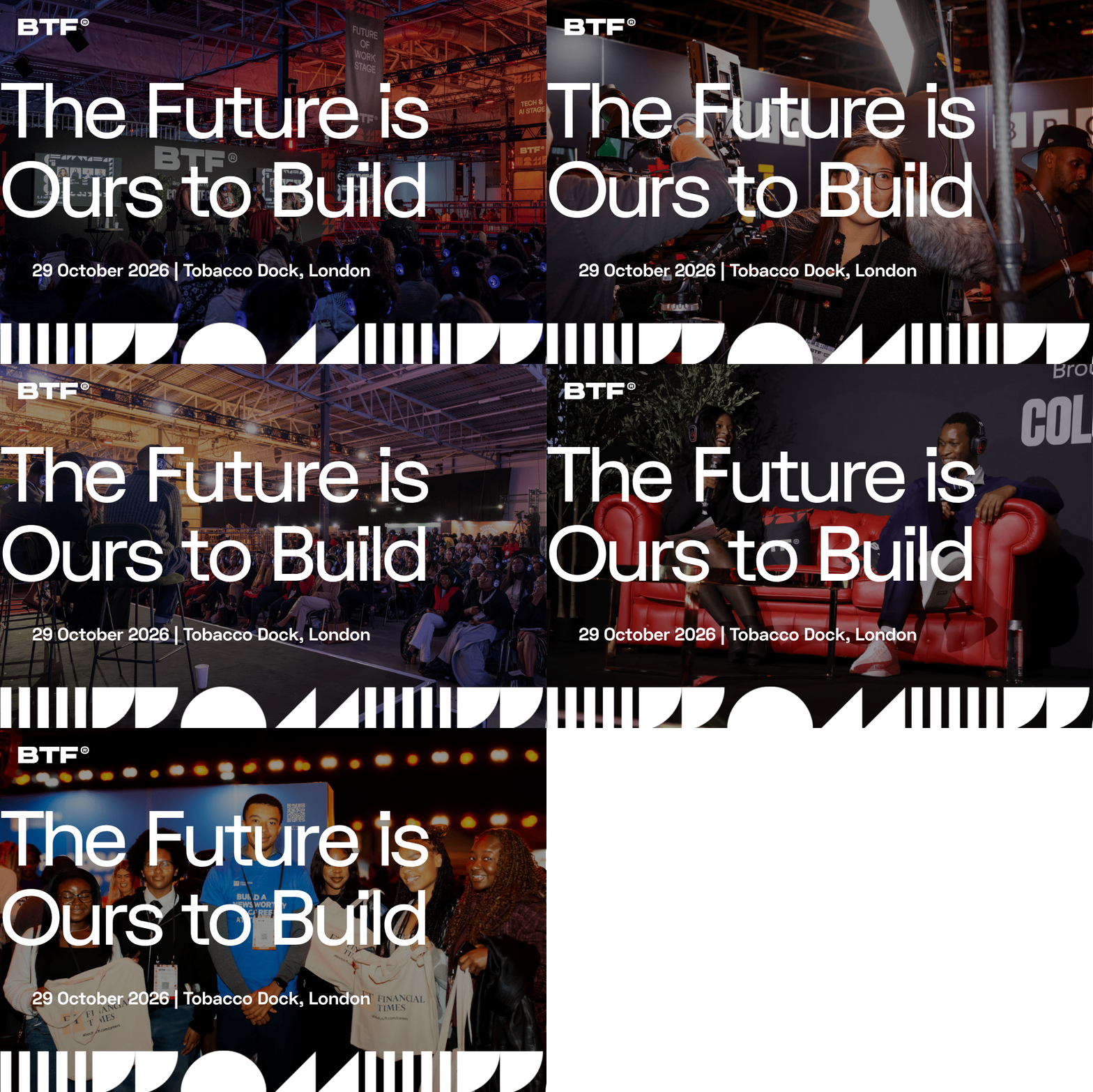
๐Ÿ˜ƒBTF is back๐Ÿ˜ƒ


Yep we're going to call this the "best tech festival" is back

  • October 29th 

  • New venue, Tobacco Docks

  • Early bird price tickets (the same as last year)

Check it out. Joinbtf.com


๐Ÿ™Œ๐ŸพThe latest from the Colorintech team๐Ÿ™Œ๐Ÿพ

๐Ÿ˜ƒWhat we are consuming๐Ÿ˜ƒ


๐ŸŽงAI's energy footprint

๐Ÿ’ฐAMD invests in the UK

๐Ÿ’ปGoogle will pay SpaceX $920M per month for compute

๐Ÿ˜ฑ12,060 piece, $799.99, Sagrada Famรญlia is the largest Lego building set to date


Email Marketing by ActiveCampaign